


This page focuses on advice for choosing and buying the mbira instrument popularly known as Nhare (telephone) or Mbira Dzavadzimu (mbira of the ancestral spirits). These names come from its traditional ceremonial function, where the instrument is used as a tool for calling upon ancestral wisdom.
Note Layouts on the Mbira Instrument
Different mbira instruments can have different numbers of notes. This quick overview will help you understand what to look out for, and why.
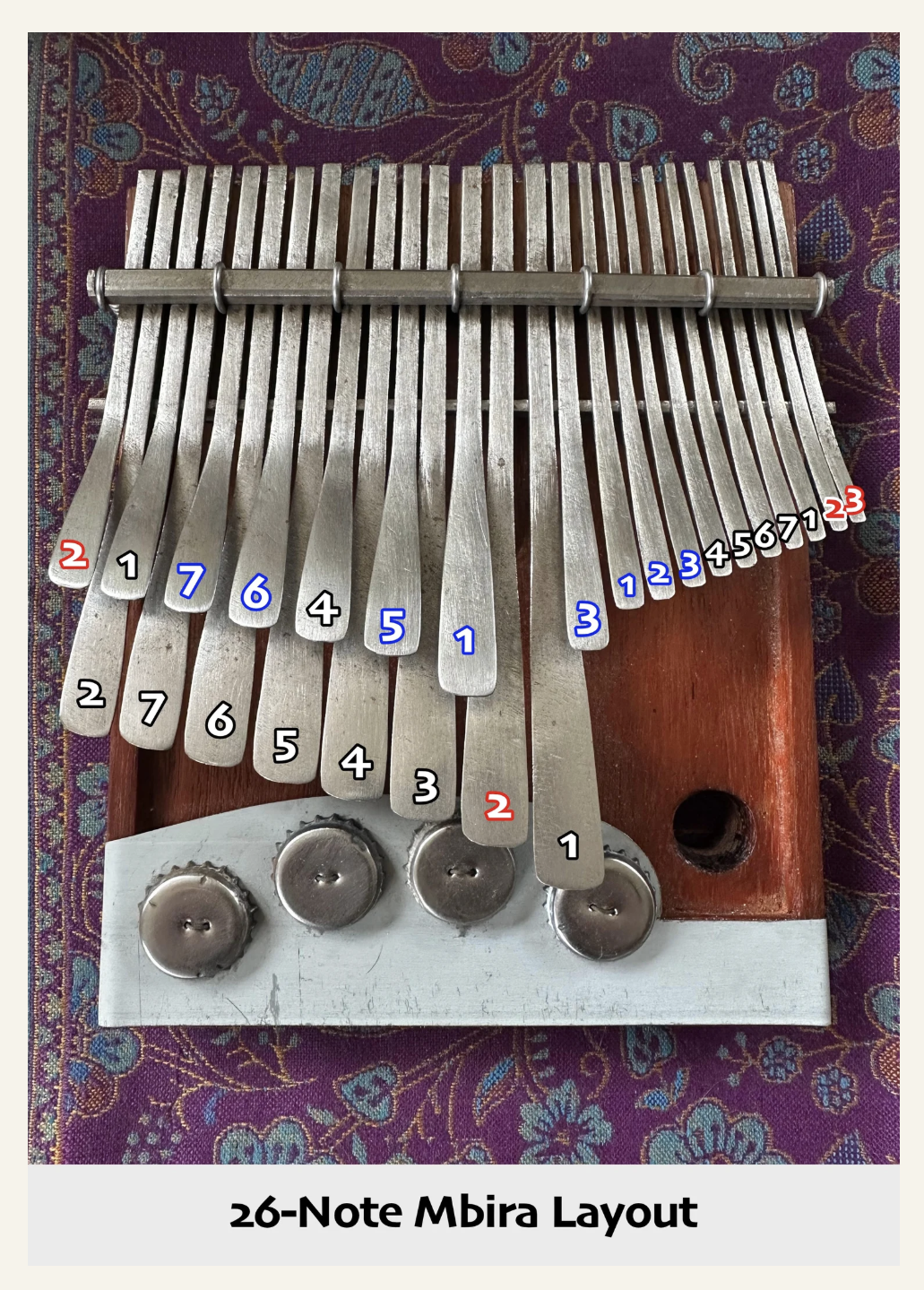
The mbira instrument has a seven-note scale, numbered 1-7 in the picture
Notes that have the same numbers have similar sounds and relationships, much like the repeating series of seven white keys found up and down a piano
Blue notes in the picture reveal a ‘core layout’ that is believed to have been inherited from on older type of mbira
This ‘core layout’ follows a logic that I explore elsewhere
New notes, added later in the instrument’s evolution, are shown in black and red - these all count upward and outward steadily
Black notes were added first, creating a popular and established mbira dzavadzimu layout - lots of older song variations stay within the blue and black regions
Red notes are the most recent additions, favoured by many of today’s mbira makers/players - some add even more to the outer edges, or ‘wings’, of the instrument
If you’re looking to buy this style of mbira, make sure it has all the blue and black notes as a minimum. You should see:
at least 7 notes in the lower left register
at least 6 notes in the upper left register
at least 8 or 9 notes in the right register
No obvious gaps between notes along the top edge of the instrument
No big jumps in note sizes - except for between the low 3 and 1 in the right register (as seen in the picture)
With all of that covered, your instrument is likely to have the notes required for playing traditional mbira songs
Mbira Tunings + Western Scales
Everything you need to know about choosing mbira tunings: which Tuning is best for beginners, and how mbira tunings correspond to Western scales.
Learn about different tunings & what to consider when buying an mbira - with examples from a few diffferent makers.

Video Summary:
Nyamaropa is the most popular tuning - both inside and outside of Zimbabwe
In this recommended tuning, which is close to a ‘Mixolydian’ scale, Note 4 sounds closest to the root/home note of a major scale
The second most popular tuning is called ‘Gandanga’ or ‘Mavembe’ - close to ‘phrygian’, where Note 6 has the root/home flavour
Western perspectives can be helpful for outsiders, but it’s important to remember that mbira makers aren’t aiming for a Western sound - The relationships between notes on mbiras are different, and they’re made to be that way
Most, but not all, mbira makers name their tunings using note 1 as a reference point
For example, on a ‘G’ Nyamaropa instrument notes 1-7 will likely sound close to G A B C D E F - (see how note 4, ‘C’, is the root of the C major scale?)
Check with your maker which note they are referring to when they discuss the tuning. To avoid confusion, ask what the lowest note is, or let them know what you would like it to be
Some questions to consider when choosing a tuning:
Do you want to play along with Western tuned instruments?
What tunings do people in your town/region/country play?
What tuning does your course/teacher/favourite musician play?
Singing adds a whole new depth to playing mbira, and some players choose a tuning to match. What’s your vocal range?
Mbira Sizes, Materials + Construction
How big are your hands? Are you looking for for wire- or bolt-tuned? Do you want authentic wood? Don’t want too much buzz? Here’s your options..
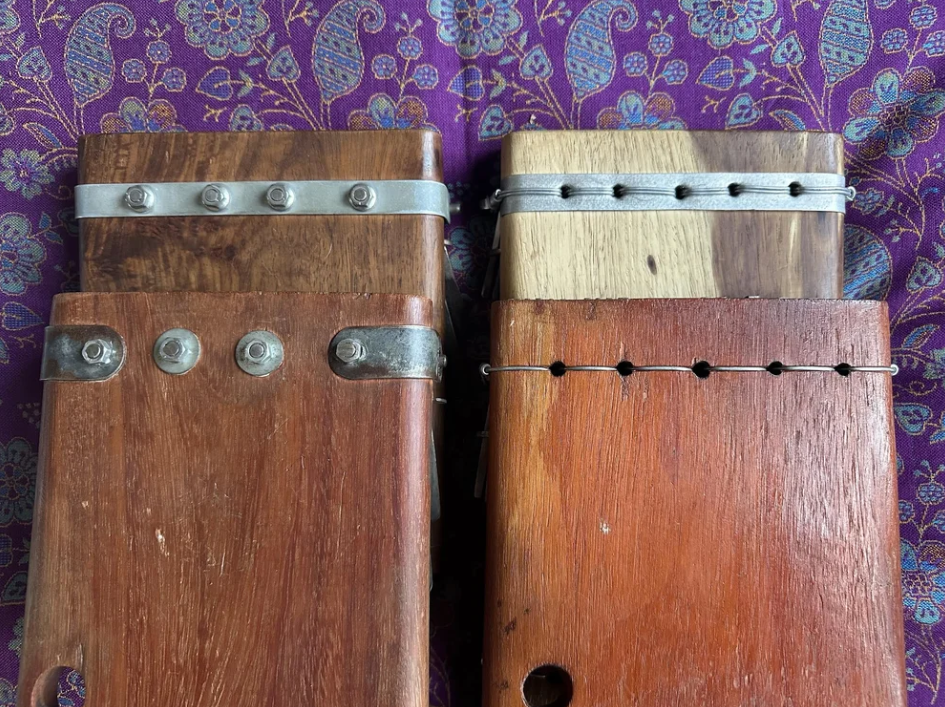
Bolt-tuned mbiras usually hold the keys in place better (left). Some mbira players prefer the sound of wire-tuned mbiras - arguing that it gives the notes more sustain (right).
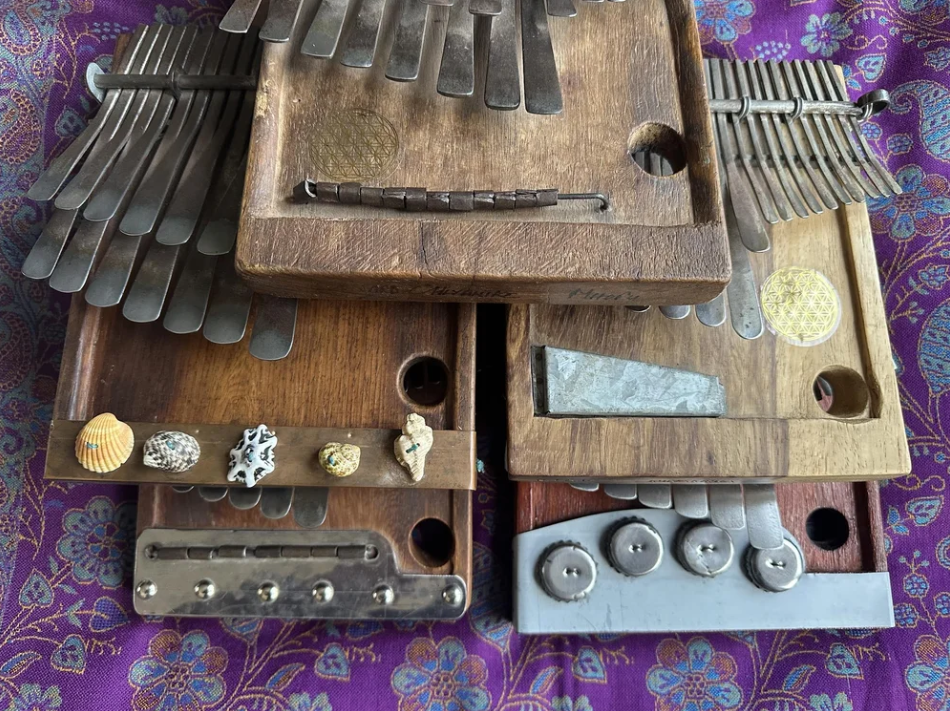
Buzzer (‘majaka’) styles: bars, shells, compartments, plates, and bottle caps.
Things to consider about the construction of your mbira:
Around 17-18cm wide and 21.5cm tall is a manageable size for most beginners
Smaller than this will be a struggle for those with larger hands - larger could also cause strain for new mbira players
The keys of the instrument can be bound to the wooden body in different ways - some people believe these different approaches affect the sound
See the first picture for examples of ‘bolt-tuned’ and ‘wire tuned’ mbira construction methods - along with comments
Wire tuned mbiras are easier to adjust - however, more care is required when working on a key, so not to affect the tension/securing of neighbouring keys
Snail shells were once used to create a buzzing sound, integral to the music
Today different makers attach a variety of buzzer (‘majaka’) styles - these can often help to identify the maker of an instrument (second picture)
Buzzer bars usually produce the lightest sound - sea shells on metal plates can be the loudest
Some people say the different rows of keys mimic different voices in the community, and that the buzzers represent or call the ancestors
Because of this, instruments without buzzers are rare - except for in recording scenarios where the sound can be too disruptive (look out for sound dampening attempts with elastic bands, tucked pieces of paper, or removal of buzzer-plates)
Traditionally the wood used for the ‘gwariva’ (body or soundboard) was Mukwa/Mubvamaropa - sometimes known as ‘Bloodwood’ because of its red sap
Lack of availability and environmental concerns mean more and more makers inside and outside of Zimbabwe are exploring the use of different woods - with differing results
The ends of each key can be rounded or square - round edges are gentler on fingertips and nails
You’ll also see ‘half-rounded’ keys (where the outer, playing edge, is rounded and the inner edge is square), ‘Samurai-’ or ‘Spine-style’ keys (with a ridge hammered up the middle), and tinted keys
All of these features come together to create a signature style, unique to the maker - be respectful of this before asking them to make something different
Typical Prices + Other Considerations
How much should you expect to pay? What else should you look out for with different makers?
Listen to two mbira instruments in the ‘same’ tuning and understand the three main differences to look out for between mbira makers.
It can take around three days to build a decent mbira
This time includes crafting the wood, hammering and fitting each key - sometimes even more time for ‘settling in’, and fine tuning
If you find an instrument for less than $200 there’s likely to be issues around quality or exploitation
Sometimes you can pick up a second-hand bargain, or find a cheap option that generates fast cash for someone in an emergency, but please try to pay a fair price
Think: how much do you earn for three days work?
A good quality instrument will inspire you to continue playing for years to come - ending up costing you just a few pence per hour
When buying an instrument, maybe remember the popular saying, ‘quality remains long after the price is forgotten’ (varieties of this phrase attributed to Rolls Royce, Gucci, and Benjamin Franklin)
Be careful, buying an instrument in the ‘same’ tuning as another isn’t easy - for three main reasons:
Different makers tune the notes of their mbiras differently - for example, the popular ‘Bb Nyamaropa’ of players Cosmas Magaya, Musekiwa Chingodza, and Chartwell Dutiro are all slightly different
Metal keys produce secondary notes called ‘overtones’ - which some makers pay close attention to tuning (particularly across the lowest register), and others ignore
Overtones of ‘two ocatves’, ‘two octaves and a third’, and ‘two octaves and a fifth’ are among the most common
For many makers, these overtones are a by-product of their making approach, rather than something they focus on explicitly
Please get in touch with me if you’re looking for a maker that understands how to tune overtones
Because wood is a natural product, and these instruments are handmade, no two instruments will ever sound exactly alike
If you’re looking for a similar sound to something you’ve heard elsewhere, your best option is to ask who made the mbiras played by your local friends, your teacher, or your favourite musician
If possible, listen to a few instruments by the same maker to see what sounds consistent or different across their instruments
Our list of trusted makers have been selected because they offer consistency of tuning, quality, communication and delivery - download Mbira Essentials (FREE) for their instrument photos/prices and contact details
Return to our ‘How To Buy Mbira’ page for a quick overview of your buying options, including updated information about International Postage From Zimbabwe: